
Meet Luana Lopes Lara, the former Bolshoi ballerina who learned to code at MIT and founded Kalshi. Discover how she became history’s youngest self-made female billionaire. young Brazilian woman transformed pain, precision, and probability into a billion-dollar empire.
Author: Jimmey Barnwal | December 8, 2025 | 10 min. read
When we imagine the archetype of the self-made billionaire, the image is predictable: a hoodie-wearing coder in a Silicon Valley garage, or a Wall Street prodigy surrounded by blinking terminals. But Luana Lopes Lara—today the youngest self-made female billionaire in history at just 29—came from a world defined by pointe shoes, classical music, and the uncompromising discipline of ballet.
Her story reads like a novel—one where the protagonist leaps from the stage to the stock exchange, turning years of physical endurance and emotional grit into the foundation of one of the most disruptive fintech companies of the decade.
Early Life: Bolshoi Ballet and the Discipline of Dance
Born in Santa Catarina, Brazil, raised within a Catholic household, Luana’s early years were a universe apart from the American tech scene she would later conquer. Her first language was Portuguese, her first dream was dance, and her first crucible was the Bolshoi.
She trained at the Escola do Teatro Bolshoi no Brasil, the only Bolshoi academy outside Russia. This was no hobby—this was survival through suffering.
Ten hours a day. Every day.
Bleeding toes, bruised legs, endless rehearsals.
Ballet wasn’t just art. It was engineering of the body. It was mathematics of movement. It was discipline hammered into muscle memory.
At 18, she graduated and joined a ballet company in Austria. She danced in Swan Lake, performed across Europe, and seemed destined for a life of curtains and ovations.
But backstage, something shifted.
The applause no longer felt like purpose.
The pain no longer felt like progress.
Luana realized she was dancing someone else’s dream—not her own.
And so she did something radical for a girl conditioned not to flinch: she quit.
The Academic Pivot: From Stage to MIT Computer Science

Most people pivot slowly. Luana pivoted like a lightning strike.
She moved to the United States and enrolled at the Massachusetts Institute of Technology (MIT)—one of the hardest universities in the world.
There, she double-majored in computer science and mathematics, channeling the same obsessive precision that made her a world-class dancer into algorithms, proofs, and quantitative models.
MIT didn’t just sharpen her brain—
it widened her world.
She interned with:
- Ambev / AB InBev in Brazil
- Bridgewater Associates under Ray Dalio
- Citadel, the world’s largest hedge fund
- Five Rings Capital, a top quantitative trading firm
Inside these high-pressure environments, she learned how markets breathe, how data moves, how money thinks.
But the turning point came outside the office—on long walks home from Five Rings with another ambitious intern, Tarek Mansour, a Lebanese-born mathematician.
Two immigrants.
Two outsiders in finance.
Two minds obsessed with probability.
On those walks, a simple but powerful question emerged:
Why can’t you trade predictions the same way you trade stocks?
Why can’t you bet—not in casinos, but on reality itself?
Could the world’s debates become tradable markets?
That idea became their destiny.
| Profile | Details |
| Name | Luana Lopes Lara |
| Title | Co-founder & CTO, Kalshi |
| Age | 29 |
| Nationality | Brazilian |
| Education | MIT (Computer Science & Math), Bolshoi Ballet Academy |
| Company Valuation | ~$11 Billion (Dec 2025) |
| Estimated Net Worth | ~$1.3 Billion |
| Industry | Fintech / Prediction Markets |
Founding Kalshi: Creating the World’s First Regulated Prediction Market
In 2018, Luana and Tarek moved to New York and launched Kalshi, a platform where anyone can trade on real-world events:
- Will inflation drop this month?
- Will interest rates rise?
- Will the temperature in NYC cross 90°F tomorrow?
- Will a major candidate win the next election?
It wasn’t gambling.
It wasn’t fantasy sports.
It was a new asset class: event contracts.
Luana, as Chief Technology Officer, engineered the platform’s architecture from scratch. She designed systems capable of handling billions of outcomes, fractions of seconds in latency, and extreme volatility around major geopolitical moments.
But the biggest barrier wasn’t technical—it was regulatory.
Overcoming Regulatory Hurdles with the CFTC
For three years, Kalshi battled with the U.S. Commodity Futures Trading Commission (CFTC). Countless meetings. Endless paperwork. Analysts who didn’t understand the product. Lawyers who said, “This will never be approved.”
But in 2021, the impossible happened.
Kalshi became the first federally regulated exchange for event contracts in U.S. history.
The gates opened. The markets surged.
By 2025:
- Kalshi hit $10 billion in trading volume in a single month
- It expanded to 24 states
- Monthly trading volumes surpassed $4.5 billion
- Elections, macroeconomic indicators, and weather events became tradable assets
- AI integration (including partnerships with xAI) supercharged prediction accuracy
- The company even began exploring sports betting and tokenized markets on Solana
Kalshi wasn’t just a startup anymore.
It was becoming the NASDAQ of predictions.
Kalshi Valuation & Growth: The Path to $11 Billion
Investors saw what the public saw: a shift in global finance. And they poured money—fast.
Early Backers
- SV Angel
- Charles Schwab
- Henry Kravis (KKR founder)
Series A (2021)
- $30 million led by Sequoia Capital
Mid-2025
- $300 million round
- Valuation: $5 billion
Luana Lopes Lara’s Net Worth and Billionaire Status
- $1 billion Series E led by Paradigm
- New valuation: $11 billion
Three rounds in one year.
Total funding: over $1.3 billion.
Luana’s personal stake? Roughly 12%.
Her net worth soared to $1.3 billion, making her the youngest self-made female billionaire ever documented.
She didn’t invent a gadget.
She didn’t create a social network.
She built a market—
a market the world didn’t know it needed.
Beyond the Valuation: The Legacy She’s Building
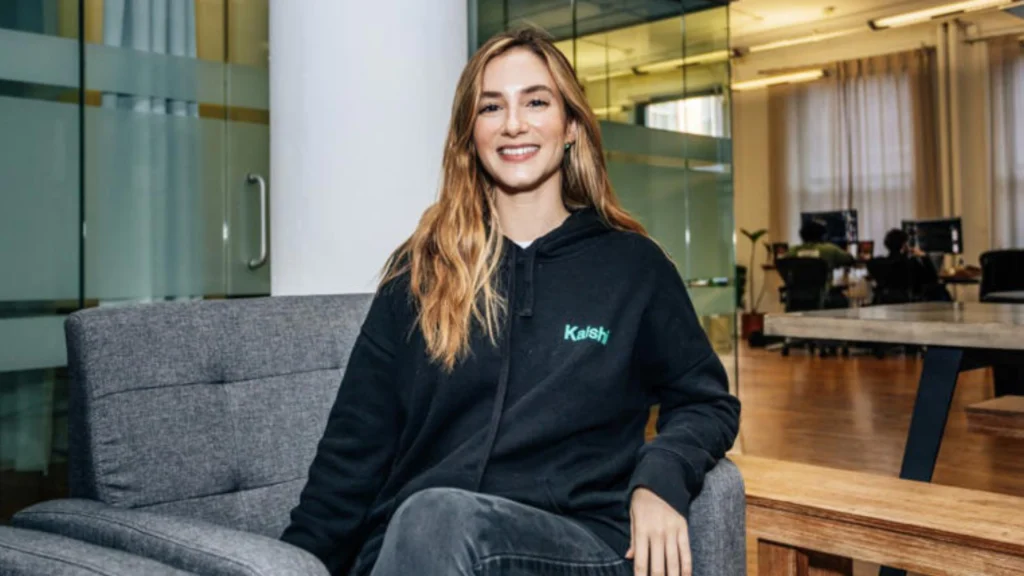
For all her achievements, Luana remains grounded in the identity that shaped her:
- A Brazilian immigrant
- A former ballerina
- A woman breaking into male-dominated arenas
- A technologist who studied human cognition
- A founder who built something no one believed in
At MIT, she even pursued a Master’s in Computational Cognitive Science, blending psychology with artificial intelligence under Dr. Max Kleiman-Weiner and Prof. Josh Tenenbaum.
Her work today, at its core, remains an extension of that study:
How do humans think about the future—and how can we model that?
On Instagram and X (@luana_lopes_lara), she shares glimpses of her life:
- Kalshi’s humble first office
- Her sister’s PhD celebration
- Quiet family moments
- Reflections on grit and immigrant ambition
To women in STEM, she is a symbol of possibility.
To founders, she is a lesson in conviction.
To regulators, she is a catalyst for a new financial paradigm.
To the world, she is proof that unconventional beginnings often create the most extraordinary outcomes.
A Final Thought: The Ballerina Who Bet on Herself
Luana Lopes Lara’s life can be summarized in one powerful arc:
She spent years learning how to endure pain.
Then she spent years learning how to quantify risk.
Then she built a company that monetized the uncertainty of the world.
Her story is not linear—it’s exponential.
She didn’t follow the traditional path to wealth.
She invented her own category.
She turned resilience into intelligence, discipline into innovation, and doubt into billion-dollar conviction.
In a world defined by unpredictable futures, Luana built the marketplace that trades them.
And she became a billionaire not by predicting the future—
but by creating the platform where the world predicts its own.
Read here more about:
“Top Fintech Startups to Watch in 2025”
- StartupBlink: Top Fintech Startups in 2025
- Built In: 100 Fintech Companies and Startups to Know
- OMNIUS: Leading US Fintech Startups to Watch in 2025
“The Rise of Prediction Markets”
- Forbes: The Polymarket Effect: How Prediction Markets Are Beating The Experts
- FinTech Global: The rise of prediction markets in FinTech
- Kavout: Prediction Markets Go Mainstream: Why Big Money Is Betting Billions
“Inspirational Women Leaders”
- Storm2: Top 100 Women in FinTech 2025
- Fintech Magazine: Top 10 female leaders inspiring change in fintech
“Kalshi’s official regulatory page”
- Link:
https://kalshi.com/regulatory/notices - Why: This points directly to their legal notices and rulebooks, proving they are CFTC regulated.
“MIT’s Computer Science department page”
- Link:
https://www.eecs.mit.edu/research/computer-science - Why: This is the specific research page for Computer Science at MIT EECS, offering better context than the generic university homepage.