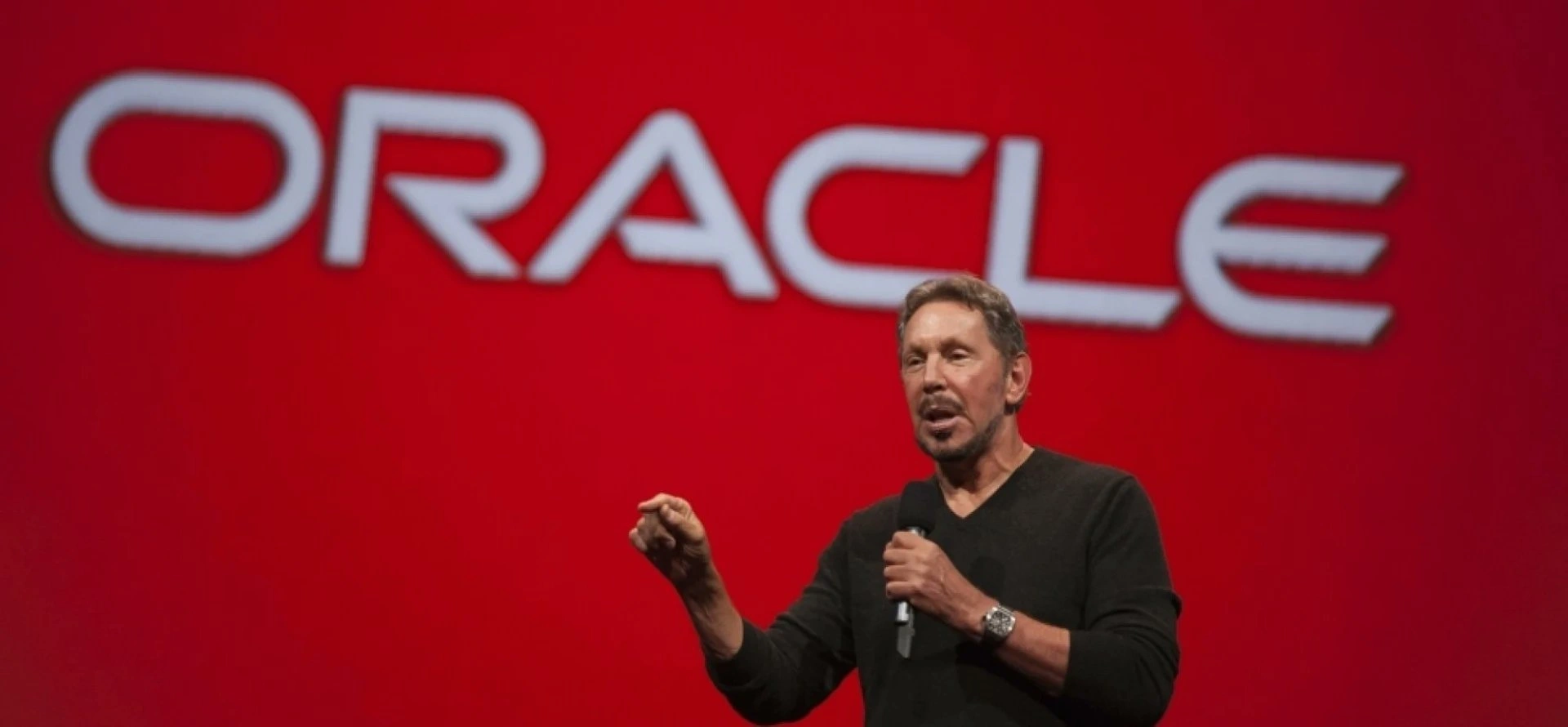
An investigative look at the $300 billion AI infrastructure risk involving Oracle, OpenAI, and Nvidia. We analyze the circular capital flows, rising debt, and credit market warnings flashing red about AI bubble.
Author: Jimmey Barnwal | December 13, 2025 | 2 min. read
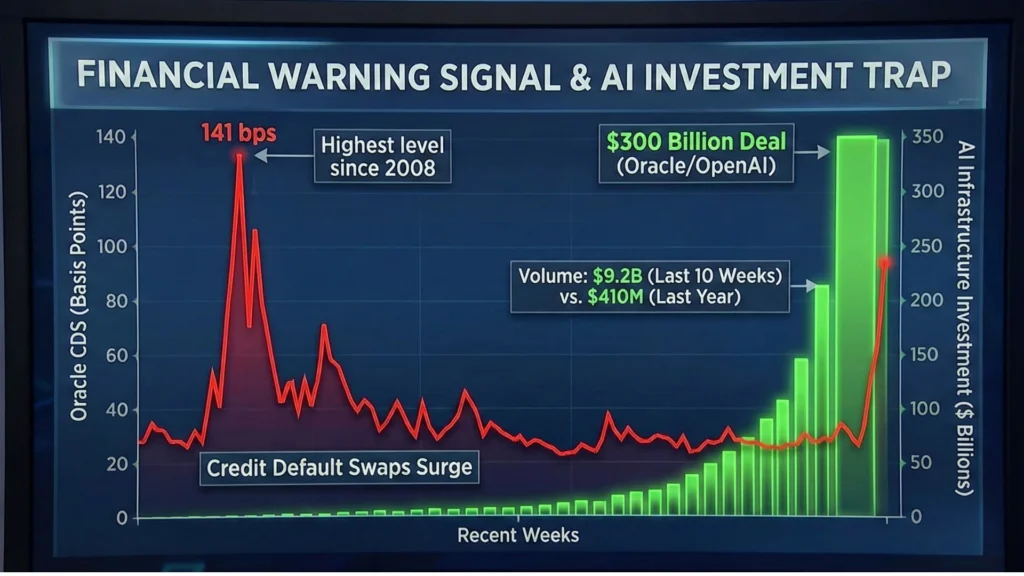
In the last 24 hours, the financial markets have quietly flashed a warning signal not seen since the global meltdown of 2008. It started with an unusual spike—Oracle’s credit default swaps (CDS) surged to 141 basis points, their highest level since Lehman Brothers was on life support.
Then came the volume:
$9.2 billion of Oracle’s credit derivatives traded in ten weeks—compared to just $410 million in the same period last year.
To the credit markets, this is not noise.
This is a scream.
Because beneath Silicon Valley’s optimism and Wall Street’s blind faith, a $300 billion structural time-bomb is ticking. And only a handful of analysts have pieced together the full picture.
The $300 Billion Gamble: Is the AI Market Flashing a 2008-Style Warning?
Two companies that have never turned a profit just signed the largest technology infrastructure deal in human history.
- Oracle committed $300 billion over five years to build AI infrastructure for
- OpenAI, whose current revenue is $13 billion.
Beginning in 2027, OpenAI is contractually obligated to pay Oracle $60 billion annually.
Let that sink in.
For OpenAI to simply afford one vendor, it must grow revenue 5x in two years—a rate faster than any software business in history.
This is not aggressive.
This is mathematically implausible.
| Metric / Event | Value / Status | Implication | Source / Verification |
| Oracle-OpenAI Deal | $300 Billion (5 Years) | Largest infra deal in history; requires 5x revenue growth. | CIO.inc / WSJ (Sept 2025) |
| Oracle CDS Spike | 141 Basis Points | Highest default risk signal since 2008 crisis. | Bloomberg / ICE Data |
| SoftBank Gap | $54.5 Billion(Shortfall) | Sold $5.8B Nvidia stake to plug liquidity hole. | The Hindu / Reuters |
| AI ROI Reality | 95% Zero ROI | “Little to no measurable impact” for most firms. | MIT Study (Aug 2025) |
| Deal Volume | $9.2 Billion | 10-week credit derivative trading volume (vs $410M last year). | Credit Market Data |
II. Oracle’s Balance Sheet: Liquidity Stress & Rising Debt
Last quarter, Oracle posted:
- –$10 billion free cash flow
- Debt rising faster than revenue
- Analysts warning of liquidity stress
Barclays projected Oracle could run out of cash by November 2026 without restructuring or dilution.
Morgan Stanley went further:
“We recommend buying protection against Oracle’s debt.”
Wall Street rarely says this about a blue-chip company unless the risk is existential.
III. The Ouroboros: The Nvidia-OpenAI-Oracle Feedback Loop
Here is the part almost nobody outside high finance understands.
This is not just a contract.
It’s a closed-loop capital cycle, a self-referential money circuit that functions only if everything grows forever.
It works like this:
1. Nvidia invests in OpenAI.
2. OpenAI uses the money to buy Nvidia chips—through Oracle’s cloud.
3. Oracle uses the incoming payments to:
- service its growing debt
- buy more Nvidia hardware
- expand AI infrastructure for OpenAI
4. The money flows back to Nvidia.
Nvidia → OpenAI → Oracle → Nvidia
The serpent devours its own tail.
Economists call this a reflexive bubble.
Historians call it a death spiral if anything breaks.
IV. SoftBank’s Role: The $54.5 Billion Funding Gap
Behind the scenes sits SoftBank, a kingmaker in global tech funding.
- $113 billion committed to AI ecosystem investments
- $58.5 billion of actual funding capacity
Meaning:
SoftBank is short by $54.5 billion.
That gap must be filled—via credit markets already flashing red.
If SoftBank cannot raise capital fast enough, the AI investment chain snaps in the middle.
V. The ROI Reality: Why Generative AI Adoption is Stalling
The entire $300 billion contract assumes one thing:
Generative AI adoption must explode—instantly, globally, and profitably.
But the real world is not cooperating.
- MIT study: 95% of organizations see zero measurable ROI from generative AI.
- McKinsey report: 8 out of 10 companies report no bottom-line impact.
This means corporate AI spending may plateau—exactly when OpenAI must scale faster than any company in modern history.
If adoption slows or stalls, the capital cycle collapses.
And because everything is interconnected, the failure is not isolated.
VI. The 36-Month Window: AI Profitability vs. Market Collapse
Every major entity in this loop—OpenAI, Oracle, Nvidia, SoftBank—has structured its commitments around a similar timeline:
AI must achieve mass commercial profitability by 2027–2028.
If not:
- Oracle defaults or dilutes
- OpenAI renegotiates or fails obligations
- SoftBank faces a liquidity crisis
- Nvidia’s demand cycle contracts violently
- The AI bubble unwinds across markets simultaneously
This is not a single domino.
This is a domino grid.
VII. Government Stance: No Bailouts for AI Infrastructure
For the first time since 2008, the White House directly addressed a tech-sector financial risk.
Their statement was blunt:
“There will be no government bailout for AI infrastructure failures.”
Translation:
If this implodes, it implodes.
The U.S. government bailed out:
- banks
- automakers
- insurers
- mortgage giants
But not AI infrastructure providers.
Not speculative capital loops.
Not companies burning tens of billions with no profits.
This is capitalism’s purest stress test.
VIII. Conclusion: Credit Markets Signal Systemic Risk
Credit markets react before equity markets because they are designed to price in survival, not optimism.
When credit signals spike:
- They are not predicting slowdown.
- They are predicting danger.
The $300 billion AI build-out is no longer a technological bet.
It is a systemic risk, one built on compression timelines, unearned optimism, and circular capital flows that collapse if any participant stumbles.
The world has entered the most precarious financial phase of the AI revolution.
If generative AI becomes the next electricity, everything works.
If it does not—even slightly—the unraveling will be swift and brutal.
The canary in the coal mine is no longer coughing.
It is silent.
And everyone is still mining.
“Oracle default fears explode as Credit Default Swap hits crisis-level highs”
Oracle’s 5-Year CDS Surges to 139 Bps… Signaling Heightened Credit Risk”
A founder’s Story: https://voice.infloia.com/the-brutal-reality-of-building-a-startup/
The Great Indian IPO Scam: TheGreatIndiaIPOScam

4 thoughts on “The $300 Billion AI Bubble: Oracle, OpenAI & The Coming Tech Crash”