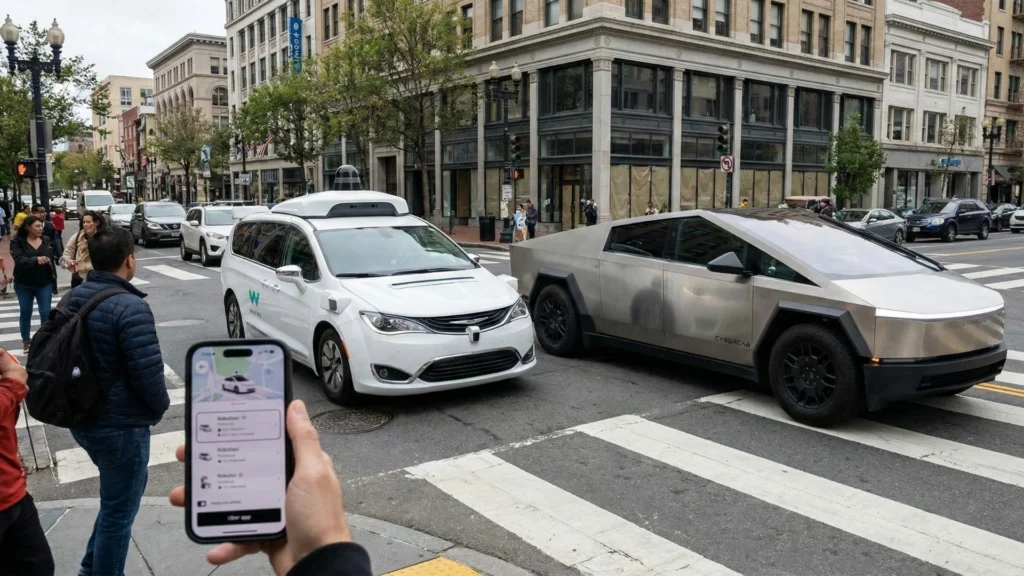
Discover how the world’s largest mobility platform may outmaneuver Tesla and Waymo in the Robotaxi revolution, leveraging its massive platform to win the $1T+ autonomous era.
Infloia’s Exclusive
Author: Jimmey Barnwal | December 14, 2025 | 5 min. read
When history looks back on the 2020s, it may label this decade as the moment human transportation detached itself from the steering wheel. What began as scattered autonomous vehicle (AV) experiments has rapidly accelerated into a global, high-stakes robotaxi race, one that analysts, investors, and insiders say could unlock trillions of dollars in enterprise value and reshape urban mobility forever.
Names dominate the conversation: Tesla, Waymo, Baidu, Cruise.
But an unexpected contender has emerged as the potential biggest winner: Uber.
This argument reached mainstream attention following a widely shared analysis on X (formerly Twitter) by investor @thexcapitalist, who claimed that Uber, despite not building its own autonomous vehicles, could end up capturing more market value than the companies inventing the technology itself.
At first glance, it seems counterintuitive.
But the more deeply you examine the data, the clearer the thesis becomes: Uber’s global scale, partnerships, and aggregator model could give it a structural advantage no hardware, maker can match.
And yet, the story is not one-sided. Tesla loyalists, Waymo advocates, and AV purists strongly dispute Uber’s inevitability.
I. Uber vs. Tesla vs. Waymo: Why the Aggregator Wins the $1T Robotaxi War
| Strategy Aspect | Waymo (The Operator) | Tesla (The Vertical Giant) | Uber (The Aggregator) |
| Tech Stack | LiDAR + HD Maps (Heavy Hardware) | Vision-Only End-to-End AI | Tech Agnostic (Partner Integration) |
| Scaling Speed | Slow: Geofenced, relies on mapping | Fast: OTA updates to millions of cars | Fastest: Instant global deployment |
| Est. Cost/Mile | High ($2.50+) due to hardware cost | Low ($0.50–$1.00) targeted | Variable (High-margin commission) |
| Geography | Primarily USA (SF, Phoenix, LA) | USA First $\to$ Global Rollout | Global Leader (US, Asia, MENA) |
| Business Model | Build, Own & Operate Fleets | Full Vertical Integration (Mfg $\to$ App) | The “App Store” Platform Model |
| Primary Risk | High Capex & Slow Expansion | Regulatory Approval & Tech Delays | Partner Dependence & Margins |
1. Global Operations: Uber Is Already Deploying Autonomous Fleets
While Tesla and Waymo concentrate their early deployments primarily within the United States, Uber has quietly begun launching robotaxi services across continents.
Middle East: The world’s first fully commercial driverless service via Uber
- Abu Dhabi and Dubai are already running robotaxis through Uber’s partnership with WeRide, marking the Middle East’s first fully commercial Level 4 driverless service.
- These deployments give Uber the early-mover advantage in some of the world’s most high-growth mobility markets.
Asia Next: A “trillion-dollar-plus opportunity”
Uber CEO Dara Khosrowshahi has stated the company aims to be active in 10+ robotaxi markets by 2026, with expansions toward:
- Hong Kong
- Japan
- Australia
Asia is projected to become Uber’s largest AV opportunity worth over $1 trillion in mobility value.
U.S. Market Penetration
Uber is integrating robotaxis in:
- Dallas (Avride)
- Los Angeles
- Austin
- Atlanta
- Other expansion markets
These partnerships allow Uber to expand rapidly without building its own fleets.
2. Technology Commoditization: Why Uber is the “App Store” of Self-Driving Cars
A major shift has occurred in the AV industry: autonomous driving technology has begun to commoditize.
This means:
- Multiple companies (WeRide, Pony.ai, Avride, May Mobility) now offer AV tech approaching Tesla or Waymo levels.
- Hardware is getting cheaper (LiDAR significantly down in price).
- AI models are converging in capability.
As AV becomes more “plug-and-play,” platform aggregators benefit, not hardware builders.
Uber becomes:
“The App Store of autonomy.”
Where:
- Tesla = iPhone
- Waymo = Samsung
- Uber = App Store distributing all apps
Regardless of which AV tech wins each city, Uber can integrate them all.
3. Uber’s Platform Advantages: A Moat Tesla Can’t Cross
Uber already operates the world’s largest mobility ecosystem:
- 12+ billion trips per year
- 156+ million monthly active users
- 50,000+ fleet partners
- Deep logistics infrastructure (insurance, routing, customer service, pricing algorithms)
An AV company starting from scratch needs years, and billions, to replicate this.
Robotaxi partners get:
- Instant user demand
- Global distribution
- Infrastructure support
- Monetization from Day 1
Uber gets:
- High-margin revenue
- Geographic scale
- No capex burn
This is why Tesla and Waymo are limited by their need to build fleets, an extremely capital-heavy bottleneck.
4. Financial Strength: Uber Revenue Growth vs. Cash-Heavy Peers
Uber is no longer a cash-burning startup.
Recent financial highlights
- 20% YoY revenue growth
- 386% EPS growth
- $6.88B net income
- $9B trailing 12-month free cash flow
Uber stock is up ~50% YTD, while Tesla is down ~22%.
Analysts project:
- $52B revenue in 2025
- $60B in 2026
- Nearly $70B in 2027
AV deployment could unlock $1 trillion in TAM (Total Addressable Market) within the U.S. alone.
Head-to-Head Comparisons
The table below summarizes key differences across dimensions, based on 2025 data and projections.
| Aspect | Waymo | Tesla | Uber |
| Technology Approach | Sensor fusion (LiDAR, radar, HD maps) with hybrid AI/programmed planning; geofenced for safety. Reaction time ~400ms; feels “robotic.” | Vision-only, end-to-end AI neural nets; adaptable anywhere. Reaction time ~20ms; “smoother, bolder” rides. | No proprietary tech; integrates partners’ AVs (e.g., Waymo for US, WeRide for Middle East). Relies on commoditization. |
| Scalability & Fleet | ~2,500 vehicles; slow growth (3,500/year projected); city-by-city mapping limits speed. | 130+ supervised; potential millions via existing cars + 1M Cybercabs/year by 2027; OTA for instant updates. | No owned fleet; accesses partners’ (e.g., 5,000 Nvidia-powered); scales via app in 10+ markets. |
| Cost & Economics | High: $2.50+/mile, $2B annual losses; vehicles expensive, leading to higher fares. | Low: $0.50-1/mile, 60-100% margins projected; cheaper production enables price wars. | Variable: Takes cut (e.g., 20-30%) from partners; no R&D burden, but dependent on others’ costs. |
| Geographic Focus | US-centric (SF, Phoenix, Austin, LA); international testing (London, Tokyo). | US start (Austin, Bay Area); global via app/FSD in existing markets (e.g., Australia access). | Global leader; active in Middle East/Asia (e.g., Abu Dhabi with WeRide); 10 markets by 2026. |
| Business Model & Risks | Owns tech/fleet; risks: high losses, regulatory scrutiny (e.g., CA rules fights). | Owns end-to-end; risks: delays in unsupervised FSD, competition from cheaper fares. | Aggregator; risks: partner dependencies, margin erosion if tech commoditizes too fast. |
II.Counterarguments: Tesla FSD and Waymo Safety Advantages
Balanced analysis requires looking at the strongest opposing views.
1. Tesla’s Vertical Integration Could Dominate Margins
ARK Invest, Morgan Stanley, and Tesla analysts argue:
- Tesla’s full-stack control (manufacturing → batteries → hardware → AI → deployment) allows robotaxi margins of 60–100%.
- Tesla FSD v14 could become globally unsupervised.
- Some models estimate 90% of Tesla’s enterprise value will come from robotaxis by 2029.
Tesla could achieve:
- $250B revenue from robotaxis by 2040
- $3–5 trillion valuation upside
If Tesla achieves true unsupervised FSD across continents, Uber’s aggregator model becomes unnecessary.
2. Waymo Has the Safest, Highest-Quality Robotaxi
Waymo:
- Runs 450,000+ rides per week (projected 1M/week by 2026).
- Controls 10%+ market share in San Francisco.
- Expands to London and Tokyo.
Waymo advocates argue:
- Safety leadership (lowest crash rate)
- High consumer trust
- Superior sensor fusion system
If safety becomes the deciding regulatory factor, Waymo may surpass both Tesla and Uber-integrated fleets.
3. Uber’s Dependence on Partners Is a Strategic Weakness
Uber does not own:
- Hardware
- AI software
- Fleets
- Mapping systems
If AV providers eventually want to:
- Own the customer
- Maximize margins
- Build their own channels
They may bypass Uber entirely.
Tesla, for instance, will not share revenue with Uber.
III. How Uber Could Still Win the Long Game
It’s Long Run Game, How the Aggregator Model Wins?
1. Fragmented Winners = Uber Becomes the Universal Layer
It is increasingly clear different cities will have different AV winners.
Example:
- Dubai → WeRide
- Austin → Tesla or Avride
- Tokyo → Waymo
- Guangzhou → Baidu Apollo
- Los Angeles → Cruise/Waymo mix
This fragmentation is terrible for individual AV companies but perfect for Uber, which can unify all services into a single interface, just as Expedia aggregates hotels and airlines that compete fiercely behind the scenes.
Uber’s advantage grows when:
- AV tech diverges
- Regulations differ
- Companies cannot scale globally
Uber thrives as the neutral orchestrator.
2. Economics Favor Aggregators
Robotaxi fares without drivers could fall 50–70%.
Lower fares = massive demand expansion = billions of additional trips.
Uber wins because:
- It controls demand generation
- It takes a cut of every transaction
- It doesn’t pay for vehicles
Even if Tesla is cheaper per mile, Uber may win on convenience, reliability, and global presence.
IV. The Investment Landscape: Billions Flowing into AV + Robotaxi Companies
Uber
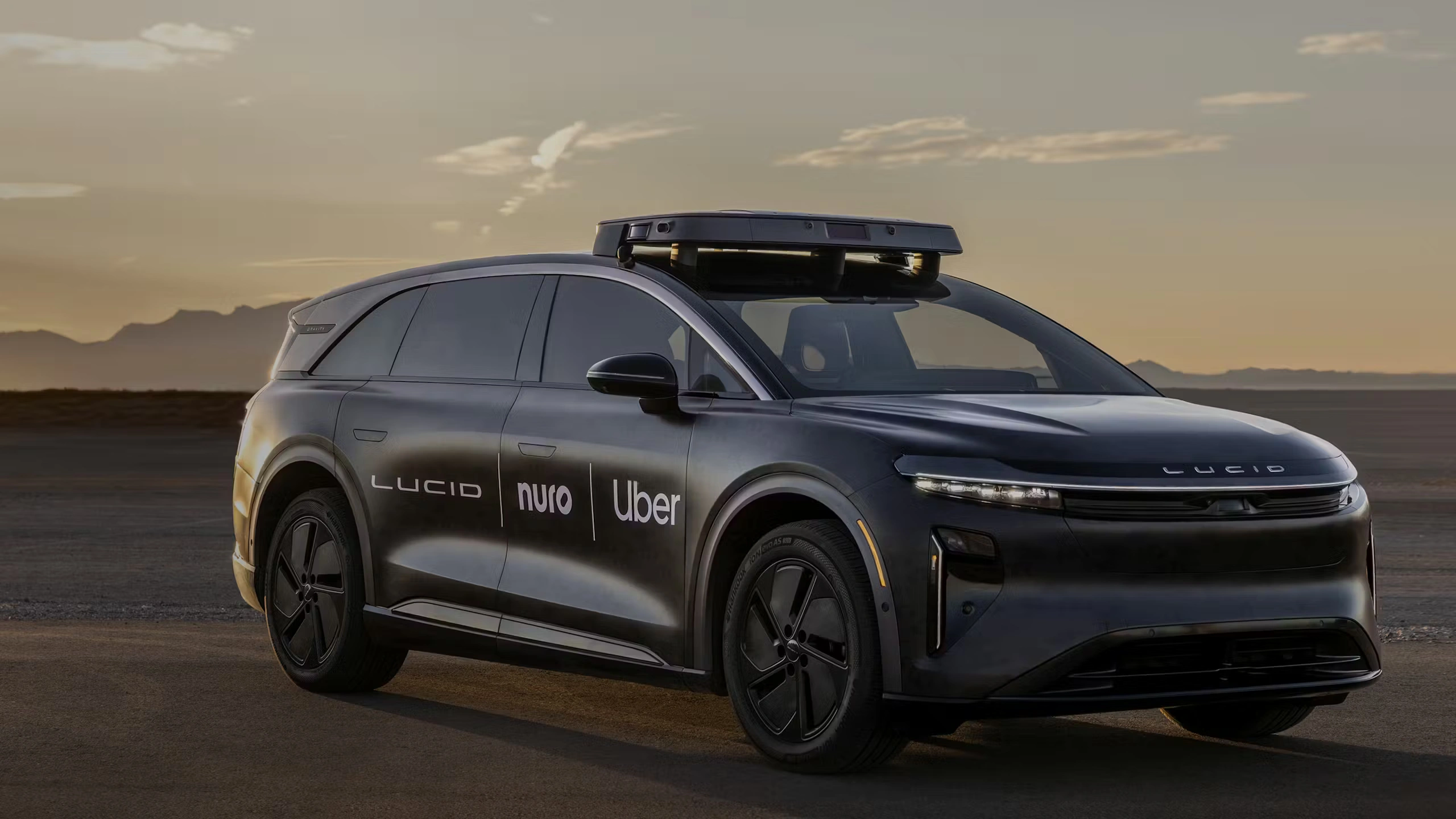
- Investments in Lucid, Nuro
- Partnerships with WeRide, Avride, Waymo, Pony.ai, Cruise
- Potential $375M investment into Avride (Oct 2025)
Waymo (Alphabet)
- Billions invested since 2010
- 2,500+ vehicle fleet
- Global expansions 2025–2026
Tesla
- Internal investment critical to its $3–5T valuation models
- FSD v14 breakthrough potential
Cruise
- $10B+ invested by GM
- Peak valuation $30B
- Collapsed into GM after 2023 incident and 2024–25 funding cuts
China’s Champions
- Baidu Apollo: largest global fleet
- WeRide: first public robotaxi company
- Pony.ai: expanding to Dubai, Europe
Emerging Players
- Avride (Nebius): Integrating with Uber
- Zoox (Amazon): Competing through logistics synergy
- AutoX, Motional, DiDi, Rivian, Lucid
The race is distributed, not winner-takes-all. Again, a structural advantage for Uber.
V. The Robotaxi Market Outlook: $40B by 2030 → Trillions by 2040
Research firms predict:
By 2030
- $40–45B global market
- 70–90% CAGR
- 1M+ robotaxis worldwide
- U.S. alone: $1T TAM (Morgan Stanley)
By 2035–2040
- Trillion-dollar annual revenues for leaders
- 5–10B autonomous miles per month
- Robotaxis replacing much of human-driven ride-hailing
ARK Invest’s most aggressive thesis:
The global robotaxi market could reach $10 trillion by 2029–2030.
Skeptics argue regulation will slow adoption to a sub-50% CAGR, but the trajectory is undeniable.
VI. Waymo vs Tesla vs Uber: Strategy Comparison
| Aspect | Waymo | Tesla | Uber |
| Tech Approach | LiDAR + HD maps | Vision-only end-to-end AI | Integrates third-party AVs |
| Scaling | Slow (mapping needed) | Fast (OTA across millions of cars) | Fastest (no fleet to build) |
| Cost per mile | $2.50+ | $0.50–$1 | Variable; Uber takes a cut |
| Geography | Mostly US | US → Global | Global leader already |
| Business model | Build + operate fleets | Fully vertical | Platform aggregator |
| Risks | High capex, slow scale | Regulatory delay | Dependence on partners |
Each strategy has unique strengths—but only Uber benefits when everybody else succeeds.
VII. Cruise Case Study: A $10B Lesson in AV Risk
Cruise represents the sobering reality of the robotaxi industry.
Highlights:
- Raised ~$12–16B total
- Valuation peak ~$30B
- Investors: GM, Honda, SoftBank, Microsoft
- Safety incident in 2023 → regulatory freeze
- Funding collapsed in 2024–25
- GM absorbed Cruise, cut workforce by 50%, ended robotaxi funding
Cruise shows:
- AV scaling is massively expensive
- Safety mistakes carry existential risk
- Building fleets is capital-intensive
This again strengthens Uber’s aggregator thesis: the platform avoids these risks entirely.
VIII. Final Analysis: Who Ultimately Wins the Robotaxi Revolution?
After synthesizing all available research, three outcomes are plausible.
Scenario 1: Tesla Dominates (Most Bullish on Tech)
If Tesla achieves:
- Global unsupervised FSD
- Super-cheap Cybercabs
- High reliability and safety
Then Tesla may control end-to-end robotaxi economics, making platforms like Uber less essential.
Probability: Moderate
Scenario 2: Waymo Wins on Safety + Regulatory Trust
Waymo’s advantage:
- Safest AV in the world
- Highest public trust
- Strong international partnerships (London, Tokyo)
This matters if regulators prioritize safety above all else.
Probability: Moderate
Scenario 3: Uber Emerges as the Biggest Winner (Aggregator Triumphs)
Uber wins if:
- AV tech remains fragmented
- Multiple winners appear city by city
- No single company conquers global markets
- AV tech becomes fully commoditized
In this scenario:
- Uber integrates all AV providers
- Takes a high-margin cut from each
- Controls the global mobility interface
- Avoids capex entirely
Uber becomes the default operating system for urban transportation.
Probability: High, given current global fragmentation.
Conclusion: The Most Likely Future
The robotaxi revolution will not crown a single global winner.
But if the autonomous mobility market evolves like smartphones, cloud computing, or online retail—where infrastructure is fragmented but platforms unify the user experience—then Uber is positioned to become the biggest financial winner, even without making a single self-driving car.
Tesla may own the most valuable technology.
Waymo may operate the safest fleets.
But Uber may control the customer, and the marketplace.
In a trillion-dollar mobility world, control of the marketplace may matter more than control of the machine.
Here’s the post:
Read more about: https://voice.infloia.com/ai-bubble-oracle-openai-nvidia-crisis/
The Future of Personal Branding: The future of personal branding won’t belong to the loudest — it’ll belong to the most efficient.
The Great Indian IPO Scam: The Great Indian IPO Scam: How Retail Investors are getting fooled?
Top Sources:
I. Uber’s Robotaxi Partnerships & Global Expansion
- Uber & WeRide in the Middle East (First Commercial L4 Service):
- Official Press Release (Nov 2025): WeRide and Uber Launch Middle East’s First Fully Driverless Robotaxi Commercial Operations in Abu Dhabi
- Dubai Expansion (Dec 2025): WeRide and Uber Launch Autonomous Robotaxi Rides in Dubai
- Uber & Avride (Dallas/Austin/Jersey City):
- Official Launch (Dec 2025): Uber and Avride Launch Robotaxi Rides in Dallas
- Strategic Investment ($375M): Avride secures strategic investment backed by Uber and Nebius
- CEO Dara Khosrowshahi’s “10+ Markets by 2026” Goal:
II. Market Size & Financial Data
- ARK Invest’s $10 Trillion Market & Tesla Valuation:
- Research Paper: Tesla Has Launched Its Robotaxi…Now What? (ARK Invest)
- Morgan Stanley’s $1 Trillion U.S. TAM:
- Report: Driving Change: Autonomous Vehicles Revisited (PDF)
- Supplementary Analysis: AI Is Coming to Your Steering Wheel
III. Competitor Data: Waymo & Tesla
- Waymo’s 450,000 Weekly Rides Milestone:
- Source (Dec 2025): Waymo hits 450,000 weekly rides in US (TechInAsia via CNBC/Tiger Global)
- Tesla “Unsupervised FSD” Projections:
- Piper Sandler / Morgan Stanley Analysis: Tesla FSD Statistic Impresses Wall Street: ‘Very Close to Unsupervised’ (Teslarati)
IV. The Cautionary Tale: Cruise
- GM Cutting Funding & Restructuring (Dec 2024):