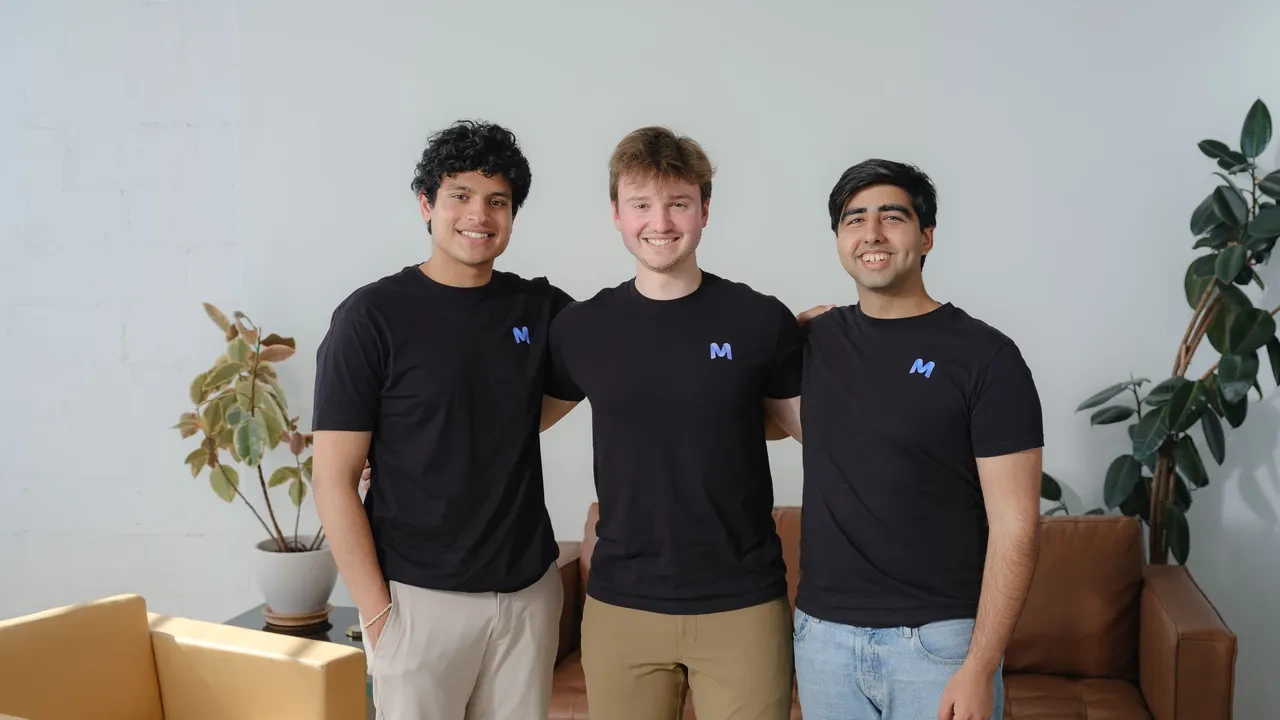
Discover the story of Mercor AI. How Adarsh Hiremath and Surya Midha turned a $10B valuation and $500M ARR into the fastest startup growth story in history.
Startup Stories
Author: Jimmey Barnwal | December 13, 2025 | 2 min. read
Silicon Valley has no shortage of prodigies.
But once in a generation, a story emerges that feels larger than ambition, larger than capital, larger even than technology.
Mercor AI is one such story.
At first glance, it looks like another AI success tale: three 22-year-olds, a $10 billion valuation, $500 million in annual recurring revenue, and record-breaking growth that outpaced even ChatGPT. But beneath the headlines lies a deeper narrative, one rooted in immigrant courage, Indian intellectual heritage, and a lifelong obsession with debate, persuasion, and human potential.
At the center of this story stand Adarsh Hiremath and Surya Midha, two Indian-origin founders whose journey, from their parents’ migration from India to the creation of a new global labor market, captures the modern Indian diaspora’s most powerful arc.
This is not a story about dropping out of college.
It is a story about where ideas are born, how talent is wasted, and who gets access to opportunity.
The Immigrant Roots of Mercor’s Founders: Every startup story begins earlier than people think
Every startup story begins earlier than people think.
For Adarsh Hiremath, it began in Karnataka, where his parents grew up in a culture that revered education as the ultimate escape velocity. Karnataka, home to Bengaluru, India’s technology capital, has long produced engineers, researchers, and system-builders. When his parents immigrated to the United States, they carried with them a belief deeply ingrained in Indian households:
Education is security. Hard work is survival. Excellence is non-negotiable.
They settled in San Jose, California, raising Adarsh between two worlds, Diwali celebrations at home, AP classes and debate tournaments outside. Wealth was never guaranteed. Discipline was.
Surya Midha’s roots trace back to New Delhi, India’s political and administrative nerve center, a city defined by competition, ambition, and relentless pressure. His parents made the same leap many Indian families do: leaving behind familiarity for possibility. They settled in Mountain View, the epicenter of Silicon Valley, where the future was being coded in real time.
Surya later wrote with disarming simplicity:
“My parents immigrated to the US from New Delhi, India. I was born in Mountain View and raised in San Jose.”
Behind that sentence lies sacrifice, language barriers, cultural displacement, and the quiet pressure of making migration “worth it.”
Neither Adarsh nor Surya grew up wealthy.
But both grew up aware.
Aware that talent is everywhere.
Aware that opportunity is not.
Bellarmine College Prep: Where the First Startup Was a Debate Team
They met at Bellarmine College Preparatory, an elite Jesuit school known for producing leaders, but what truly forged their bond was competitive debate.
At just 10 years old, Adarsh and Surya were already debating high schoolers in Lincoln-Douglas formats. They lost. They won. They argued late into the night.
Debate was not extracurricular, it was identity.
- It taught them how to think under pressure
- How to dismantle arguments logically
- How to persuade, not just speak
- How to lose, publicly, and come back stronger
Adarsh once joked he’d never forgive Surya for knocking him out of a middle-school championship.
But those debate rounds became their first startup simulation:
- Shared equity in outcomes
- Emotional highs and brutal losses
- Long-term trust forged under stress
By high school, Brendan Foody, their third co-founder, joined the team. Dyslexic, unconventional, and deeply curious about labor markets, Brendan completed the triangle.
They didn’t know it yet, but they were rehearsing for Silicon Valley.
From Elite Universities to the Thiel Fellowship
The trio followed the “correct” path:
- Adarsh → Harvard (Computer Science)
Research assistant in macroeconomics under a former U.S. Treasury Secretary. - Surya → Foreign Service (Georgetown)
Drawn to global systems, geopolitics, and persuasion. - Brendan → Georgetown (Foreign Service & Economics)
Obsessed with labor inefficiencies and human capital.
But by 2023, something became impossible to ignore.
AI was accelerating faster than institutions could adapt.
And the world’s largest market, labor—was still broken.
Hiring was slow.
Talent matching was irrational.
Brilliant people were invisible because of geography, pedigree, or imperfect signaling.
For Adarsh and Surya, children of immigrants who had lived that inefficiency, the problem was personal.
So they made the decision most families fear.
They dropped out.
The Thiel Fellowship: Permission to Bet on Yourself
Becoming Thiel Fellows changed everything.
Each founder received $100,000 in non-dilutive funding, but more importantly, they received permission.
Permission to:
- Ignore credentials
- Build before asking
- Move fast without institutional approval
For Indian-origin founders especially, this was radical. Many immigrant households see college as sacred ground.
But the fellowship wasn’t about rebellion, it was about execution.
They rented a tiny Palo Alto office, barely larger than a conference room.
Mercor was born.
Mercor’s Business Model: Matching Global Experts with AI Labs
The initial idea was deceptively simple:
Match elite global talent, starting with India, to companies that desperately needed expertise.
Early Mercor used:
- Discord
- Spreadsheets
- Manual vetting
- Human judgment
Surya manually ran payments.
Adarsh built the technical backbone.
Brendan obsessed over labor economics.
They focused on AI labs, which faced a massive bottleneck:
training models required human expertise, lawyers, doctors, engineers, at scale.
Corporations wouldn’t share internal data.
So Mercor hired ex-employees instead.
Pay: $95–$500/hour
Speed: days, not months
Quality: obsessively measured
This wasn’t outsourcing.
This was precision matching.
The Breakthrough: Turning Hiring Into a Machine-Learning Problem
Here’s where Mercor quietly became dangerous.
Instead of treating hiring as judgment, they treated it as prediction.
Every short-term contract became a data point.
Every outcome fed the model.
Every feedback loop refined the system.
Humans are bad at predicting performance.
AI isn’t, if trained correctly.
This insight, born from debate logic and immigrant pragmatism, became Mercor’s moat.
By late 2024:
- 0% churn
- 1,600% net revenue retention
- Explosive demand from top AI labs
One meeting with xAI changed their trajectory permanently.
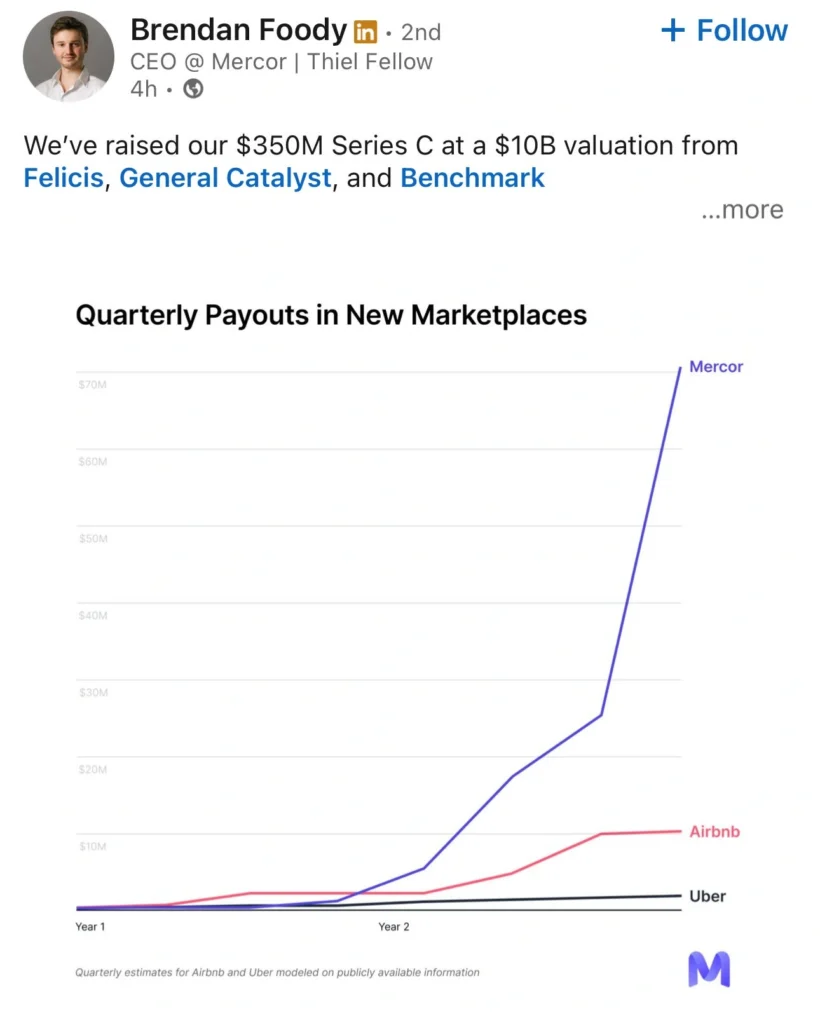
Hypergrowth: Records That Shouldn’t Exist
What followed defied startup physics.
- $1M → $500M ARR in 17 months
- 6,400% growth in 2024
- 19% weekly growth at peak
- $1.5M paid out daily to contractors
- Contractors across software, medicine, finance
- Customers: 6 of the “Magnificent Seven” + all top AI labs
Mercor was profitable from day one.
No burn.
No vanity growth.
No bloated teams.
For two Indian-origin founders whose parents crossed oceans with nothing guaranteed, this discipline wasn’t accidental.
Funding the Right Way: Conviction Over Hype
Mercor’s funding story mirrors its philosophy.
- 2024 – $25M (Benchmark)
Backed by Peter Thiel, Jack Dorsey, Larry Summers, Adam D’Angelo - Feb 2025 – $100M Series B ($2B valuation)
Led by General Catalyst - Oct 2025 – $350M Series C ($10B valuation)
Led by Felicis Ventures
No over-funding.
No ego rounds.
No dilution theater.
Just proof → scale → proof again.
Where They Stand Today: Billionaires With a Long Memory
In October 2025, Surya stepped back as COO to become Chairman, focusing on long-term strategy.
Adarsh continues as CTO—quiet, technical, deeply reflective.
They are now among the youngest self-made billionaires in history.
But Mercor’s mission isn’t about wealth.
It’s about something Indian immigrants understand instinctively:
Talent is evenly distributed.
Opportunity is not.
Mercor aims to fix that—globally.
From Karnataka to New Delhi.
From San Jose to San Francisco.
From debate desks to redefining how the world works.
Final Thought: This Is Not the End of the Debate
Mercor isn’t a company.
It’s an argument.
An argument that:
- AI should amplify, not erase humans
- Credentials matter less than capability
- Geography should not decide destiny
For Adarsh Hiremath and Surya Midha, this is more than entrepreneurship.
It is the continuation of their parents’ journey, just written in code instead of visas.
And the debate?
It’s only getting started.
More About founders:
- Thiel Fellowship:
thielfellowship.org(Official Site) oren.wikipedia.org/wiki/Thiel_Fellowship - $500 million in annual recurring revenue:
investopedia.com/terms/a/arr.asp - Lincoln-Douglas debate:
speechanddebate.org(National Speech & Debate Association).
Our Best Reports:
- The Great Indian IPO Scam: voice.infloia.com/the-great-indian-ipo-scam
- While other AI sectors face financial risks: https://voice.infloia.com/ai-bubble-oracle-openai-nvidia-crisis/
- The Brutal, Beautiful Reality of Building a Startup: https://voice.infloia.com/the-brutal-reality-of-building-a-startup/